Lombok
Lombok
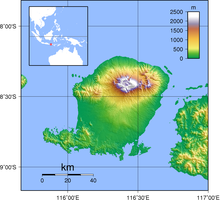
Topography of the island |
| Geography |
| Location | South East Asia |
| Coordinates |  8°33′54″S 116°21′04″E / 8.565°S 116.351°E / -8.565; 116.351 8°33′54″S 116°21′04″E / 8.565°S 116.351°E / -8.565; 116.351 |
| Archipelago | Lesser Sunda Islands |
| Area | 4,725 km2 (1,824.3 sq mi) |
| Highest elevation | 3,726 m (12,224 ft) |
| Highest point | Rinjani |
| Country |
| Indonesia |
| Province | West Nusa Tenggara |
| Largest city | Mataram |
| Demographics |
| Population | 3,166,685 (as of 2010 Census) |
| Density | 670 /km2 (1,740 /sq mi) |
| Ethnic groups | Sasak, Balinese, Tionghoa-peranakan, Sumbawa people, Flores people, Arab Indonesian's |
Lombok is an
island in
West Nusa Tenggara (
Nusa Tenggara Barat or NTB) province,
Indonesia. It forms part of the chain of the
Lesser Sunda Islands, with the
Lombok Strait separating it from
Bali to the west and the
Alas Strait between it and
Sumbawa to the east. It is roughly circular, with a "tail" (
Sekotong Peninsula) to the southwest, about 70 km across and a total area of about 4,725 km² (1,825 sq mi). The provincial capital and largest city on the island is
Mataram. It is somewhat similar in size and density with neighboring
Bali and shares some cultural heritage, but is administratively part of NTB along with sparsely populated
Sumbawa. It is surrounded by a number of smaller islands locally called
Gili.
The island is home to some 3.16 million Indonesians
[1][2][3] as recorded in the decennial 2010 census, and in 4 regencies along with the provincial capital Mataram.
Administration
Lombok is under the administration of the Governor of the province of
West Nusa Tenggara (
Nusa Tenggara Barat). The island is divided into four regencies,
North Lombok Regency,
Central Lombok Regency,
East Lombok Regency and
West Lombok Regency. The province of West Nusa Teggara is administered from the provincial capital of
Mataram in West Lombok.
History
Little is known about the Lombok before the seventeenth century. Before this time it was made up of numerous competing and feuding petty states each of which were presided over by a Sasak 'prince'. This disunity was taken advantage of by the neighbouring Balinese who took control of western Lombok in the early seventeenth century. The Makassarese meanwhile invaded eastern Lombok from their colonies in neighbouring
Sumbawa. The
Dutch had first visited Lombok in 1674 and the
Dutch East India Company concluded its first treaty with the Sasak Princess of Lombok. The Balinese had managed to take over the whole island by 1750, but Balinese infighting resulted in the island being split into four feuding Balinese kingdoms. In 1838, the Mataram kingdom brought its rivals under control.
Relations between the Sasak and Balinese in western Lombok were largely harmonious and intermarriage was common. In the island's east, however, relations were less cordial and the Balinese maintained control from garrisoned forts. While Sasak village government remained in place, the village head became little more than a tax collector for the Balinese. Villagers became a kind of
serf and Sasak aristocracy lost much of its power and land holdings.
During one of the many Sasak peasant rebellions against the Balinese, Sasak chiefs sent envoys to the Dutch in Bali and invited them to rule Lombok. In June 1894, the governor general of the Dutch East Indies,
Van der Wijck, signed a treaty with Sasak rebels in eastern Lombok. He sent a large army to Lombok and the Balinese raja capitulated to Dutch demands.(see
Dutch intervention in Lombok) The younger princes however overruled the raja and attacked and routed the Dutch. The Dutch counterattacked overrunning Mataram and the raja surrendered. The entire island was annexed to the
Netherlands East Indies in 1895. The Dutch ruled over Lombok's 500,000 people with a force of no more than 250 by cultivating the support of the Balinese and Sasak aristocracy. While the period was one of deprivation for the Sasak, they Dutch are remembered as liberators from Balinese hegemony.
During
World War II a Japanese invasion force comprising elements of the 2nd Southern Expeditionary Fleet invaded and occupied the Lesser Sunda Islands, including the island of Lombok. They sailed from
Soerabaja harbour at 09:00 hrs on 8 March 1942 and proceeded towards Lombok Island. On 9 May 1942 at 17:00 hrs the fleet sailed into port of
Ampenan on Lombok Island. The Dutch defenders were soon defeated and the island occupied.
[4]
Following the cessation of hostilities the Japanese forces occupying Indonesia were withdrawn and Lombok returned temporarily to Dutch control. Following the subsequent Indonesian independence from the Dutch, the Balinese and Sasak aristocracy continued to dominate Lombok. In 1958, the island was incorporated into the province of
West Nusa Tenggara with Mataram becoming the provincial capital.
Mass killings of communists occurred across the island following
the abortive coup attempt in Jakarta and Central Java. During
President Suharto's
New Order administration, Lombok experienced a degree of stability and development but not to the extent of the boom and wealth in Java and Bali. Crop failures led to famine in 1966 and food shortages in 1973. The national government's
transmigrasi program moved a lot of people out of Lombok. The 1980s saw external developers and speculators instigate a nascent tourism boom although local's share of earnings was limited. Indonesia's political and economic crises of the late 1990s hit Lombok hard. In January 2000, riots broke out across Mataram with Christians and ethnic Chinese the main victims, with alleged
agents provocateur from outside Lombok. Tourism slumped, but in recent years has seen a renewed growth.
Geography
The
Lombok Strait lies to the immediate west of the island and this waterway marks the passage of the
biogeographical division between the fauna of the
Indomalayan ecozone and the distinctly different fauna of
Australasia that is known as the
Wallace Line, for
Alfred Russel Wallace [1]
, who first remarked upon the distinction between these two major biogeographical regions and how abrupt the boundary was between the two biomes.
[5] To the east of Lombok lies the
Alas Strait, a narrow body of water separating the island of Lombok from the nearby island of
Sumbawa to the east.
The island's topography is dominated by the centrally-located
stratovolcano Mount Rinjani, which rises to 3,726 m (12,224 ft), making the second highest volcano in Indonesia and the nation's third-highest mountain. The most recent eruption of Rinjani was in May, 2010 at Gunung Barujari. Ash was reported as rising up to two km into the atmosphere from the Barujari cone in Rinjani's caldera lake of Segara Anak.
Lava flowed into the caldera lake, pushing its temperature up and crops on the slopes of Rinjani were damaged by ash fall. The volcano, and its crater lake, 'Segara Anak' (child of the sea), are protected by the
Gunung Rinjani National Park established in 1997.
The
highlands of Lombok are forest clad and mostly undeveloped. The
lowlands are highly cultivated.
Rice,
soybeans,
coffee,
tobacco,
cotton,
cinnamon,
cacao,
cloves,
cassava,
corn,
coconuts,
copra,
bananas and
vanilla are the major crops grown in the fertile soils of the island. The southern part of the island is fertile but drier, especially toward the southern coastline.
The water supply in Lombok is stressed and this places strain upon both the water supply of the provincial capital, Mataram, and the island in general. The southern and central areas are reported to be the most critically affected. West Nusa Tenggara province in general is threatened with a water crisis caused by increasing forest and water table damage and degradation. 160 thousand hectares of a total of 1960 thousand hectares are thought to have been affected. The Head of Built Environment and Security Forest Service Forest West Nusa Tenggara Andi Pramari stated in Mataram on Wednesday, May 6, 2009 that, "If this situation is not addressed it can be expected that within five years it may be difficult for people to obtain water in this part of NTB (West Nusa Tenggara). Not only that, the productivity of agriculture in value added will fall, and the residents are experiencing water deficiency in their wells". High cases of timber theft in the region of NTB are contributing to this problem.
[6] In September 2010, Central Lombok some villagers were reported to be walking for several hours to fetch a single pail of water. Nieleando, a small coastal village about 50 kilometers from the provincial capital, Mataram, has seen dry wells for years. It has been reported that occasionally the problem escalates sufficiently for disputes and fighting between villagers to occur. The problems have been reported to be most pronounced in the sub-districts of Jonggat, Janapria, Praya Timur, Praya Barat, Praya Barat Daya and Pujut. In 2010 all six sub-districts were declared drought areas by provincial authorities.
[7] Sumbawa, the other main island of the province, also experienced severe drought in 2010, making it a province-wide issue.
[8]
List of islands
Lombok is surrounded by many islets, of which are:
- Northwest: colloquially the Gili Islands (North Lombok Regency)
- Southwest (Sekotong Peninsula, West Lombok Regency)
- Gili Nanggu
- Gili Sudak
- Gili Tangkong
- Gili Poh
- Gili Genting
- Gili Lontar
- Gili Layar
- Gili Amben
- Gili Gede
- Gili Anyaran
- Gili Layar
- Gili Asahan
| - South Coast (West Lombok Regency)
- Gili Solet
- Gili Sarang Burung
- Gili Kawu
- Southeast (East Lombok Regency)
- Gili Indah
- Gili Merengke
- Gili Belek
- Northeast (East Lombok Regency)
- Gili Lawang
- Gili Sulat
- Gili Pentangan
- Gili Bidara (Pasaran)
- Gili Lampu
|
Demographics
The island's inhabitants are 85%
Sasak whose origins are thought to have migrated from Java in the first millennium BC Other residents include an estimated 10–15%
Balinese, with the small remainder being
Tionghoa-peranakan,
Javanese,
Sumbawanese and
Arab Indonesians.
The Sasak population are culturally and linguistically closely related to the Balinese, but unlike the Hindu Balinese, the majority are Muslim and the landscape is punctuated with mosques and minarets. Islamic traditions and holidays influence the Island's daily activities.
In 2008 the Island of Lombok had 866,838 households and an average of 3.635 persons per household.
[10]
The 2010 census recorded a population of 4,496,855 people
[3] in the province of
NTB, of which 70.42% reside on Lombok, giving it a population of 3,166,685.
[11]
Religion
The island's
indigenous Sasak people are predominantly
Muslim[12] however before the arrival of
Islam Lombok experienced a long period of
Hindu and
Buddhist influence that reached the island through
Java. A minority
Balinese Hindu culture remains in Lombok. Islam may have first been brought to Lombok by traders arriving from
Sumbawa in the 17th century who then established a following in eastern Lombok. Other accounts describe the first influences arriving in the first half of the sixteenth century. According to the palm leaf manuscript Babad Lombok which contains the history of Lombok describes how Sunan Prapen was sent by his father The Susuhunan Ratu of Giri on a military expedition to Lombok and Sumbawa in order to convert the population and propagate the new
religion. However the new religion took on a highly syncretistic character, frequently mixing
animist and Hindu-Buddhist beliefs and practices with Islam.
[13]
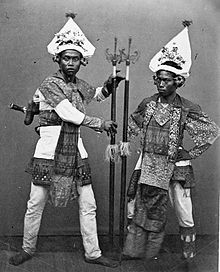
Masters of Ceremonies employed by the Balinese rulers of Lombok C1870.
A more orthodox version of Islam increased in popularity in the early twentieth century. The Indonesian government agamaization programs (acquiring of a religion) in Lombok during 1967 and 1968 led to a period of some considerable confusion in religious allegiances and practices. These agamaization programs later led to the emergence of more conformity in religious practices in Lombok. The Hindu minority religion is still practised in Lombok alongside the majority Muslim religion.
[14]
Hinduism is followed by ethnic Balinese immigrants and by a minority of the indigenous Sasak. All the main Hindu religious ceremonies are celebrated in Lombok and there are many villages throughout Lombok that have a Hindu majority population. According to local legends two of the oldest villages on the island, Bayan and Sembalun, were founded by a prince of
Majapahit.
[14]
The
Nagarakertagama, the 14th century palm leaf poem that was found on Lombok, places the island as one of the vassals of the Majapahit empire. This manuscript contained detailed descriptions of the Majapahit Kingdom and also affirmed the importance of Hindu-Buddhism in the Majapahit empire by describing temple, palaces and several ceremonial observances.
[14]
Christianity is practised by a small minority including some ethnic Chinese and immigrants from East Nusa Tenggara. The history of a small Arab community in Lombok has history dating back to early settlement by traders from Yemen. The community is still evident mainly in Ampenan, the old Port of Mataram. Due to the siting of a UNHCR refugee centre in Lombok some refugees from middle eastern countries have intermarried with Lombok people
[citation needed].
A non-orthodox Islamic group found only on Lombok are the Wektu Telu ("Three times"), who pray three times daily, instead of the five times stipulated in the
Quran. Waktu Telu beliefs are entwined with
animism, and is influenced not only by Islam, but also Hinduism and
pantheistic beliefs. There are also remnants of Boda who maintain
Pagan Sasak beliefs and could be representative of an original Sasak culture, undiluted by later Islamic innovations.
[14]
Many influences of animist belief prevail within the Sasak people, most of whom believe in the existence of spirits or
ghosts. They regard both food and prayer as indispensable whenever they seek to communicate with spirits, including the dead and ritualistic traditional practices endure.
[15] Traditional magic is practised to ward off evil and illness and to seek solutions to disputations and antipathy. Magic may be practised by an individual alone but normally a person experienced in such things is sought out to render a service. Normally money or gifts are made to this person and the most powerful practitioners are treated with considerable respect.
[citation needed]
Economy and politics
Many of the visitors to Lombok and much of the islands goods come across the Lombok Strait by sea or air links. Only 25 miles separate the two islands.
[16] Lombok is often marketed as “an unspoiled Bali,” or “Bali’s sister island.” Currently with support of the central government Lombok and Sumbawa are being developed as Indonesia 2nd destination for international and domestic tourism. Lombok has retained a more natural, uncrowded and undeveloped environment, which attract travelers who come to enjoy its relaxed pace and the opportunity to explore the island's unspoiled, spectacular natural beauty. The more contemporary marketing campaigns for Lombok/Sumbawa seek to differentiate from Bali and promote the island of Lombok as a stand alone destination. The imminent opening (2011) of the new Lombok International Airport will assist in this endeavour.
Nusa Tenggara Barat and Lombok may be considered economically depressed by
First World standards and a large majority of the population live in poverty. Still, the island is fertile, has sufficient rainfall in most areas for agriculture, and possesses a variety of climate zones. Consequently, food in abundant quantity and variety is available inexpensively at local farmer's markets, though locals still suffer from famine due to drought and subsistence farming. A family of 4 can eat rice, vegetables, and fruit for as little as US$0.50. Even though a family's income may be as small as US$1.00 per day from fishing or farming, many families are able to live a contented and productive life on such astonishingly small incomes. The people of Lombok however are coming under increasing pressure from rising food and fuel prices and access to housing, education and health services remains difficult for many of the islands indigenous population.
The percentage of the population living in poverty in urban areas of Nusa Tenggara Barat in 2008 was 29.47% and in 2009 it was 28.84%. For those living in rural areas in 2008 it was 19.73% and in 2009 it reduced marginally to 18.40% For combined urban and village the figures were 23.81% and in 2009 it fell slightly to 22.78%.
[17]
In Mataram in 2008 the percentage of the population that was unmarried was 40.74%, married 52.01%, divorced 2.51% and widowed 4.75%.
[18]
Tourism
Lombok's most important industry is tourism. The most developed of tourism area in Lombok is on the west coast of the island and centered about the township of
Senggigi. Senggigi and it's immediate surrounds contain the most developed tourism facilities in the coastal tourism strip that is spread along a 30-kilometer strip of the coastal road north from
Mataram and the nearby current airport at
Ampenan. A large number of hotels and resorts offer accommodations ranging from budget to luxurious. Approximately 1–5 kilometers offshore from the mainland lie the three highly popular
Gili Islands. These are most commonly accessed by boat from Bangsal near Pemenang, or from Senggigi. Recently direct fast boat services have been running from Bali making a direct connection to the Gili islands. Although rapidly changing in character, the Gili's still provide both a lay-back backpacker's retreat and a high class resort destination.
Other tourist destinations include
Mount Rinjani and
Kuta (distinctly different from Kuta, Bali) in south Lombok where surfing is considered some of the best in the world by leading surfing magazines. The Kuta area is also famous for its beautiful, largely deserted, white sand beaches. Sekotong, in southwest Lombok, is popular for its numerous and diverse scuba diving locations. The northern west coast near
Tanjung has many new upmarket hotel and villa developments centered about the Sire and Medana peninsular nearby to the Gili islands and a new
boating marina
at Medana bay. These new developments complement the already existing 5 star resorts and a large golf course already established there.
Pre-2000
| | This section has been nominated to be checked for its neutrality.
Discussion of this nomination can be found on the talk page. (October 2010) |
Under the
Suharto New Order, Lombok enjoyed stability and growth. Tourist development started in the mid-1980s, when Lombok attracted attention as an 'unspoiled' alternative to Bali. Initially, low budget bungalows proliferated at places like the Gili islands and Kuta, Lombok on the South Coast. These tourist accommodations were largely owned by and operated by local business entrepreneurs. Areas in close proximity to the airport, places like Sengiggi, experienced rampant land speculation for prime beachfront land by big businesses from outside Lombok.
In the 1990s the national government in Jakarta began to take a very active role in planning for and promoting Lombok's tourism. Under Suharto's autocratic rule, private organizations like the Bali Tourism Development Corporation (BTDC) and the Lombok Tourism Development Corporation (LTDC) were formed as a way for high government officials to profit personally from the tourist development projects. LTDC prepared detailed land use plans, complete with maps and areas zoned for tourist facilities. To ensure large, prime beachfront parcels would be available for development by foreign investors, Suharto and his cronies worked to purchase land, using the LTDC as a thin veil of propriety. As a result, many unsophisticated, local landholders were pressured by Suharto's henchmen to sell at bargain prices and forcefully removed from their land.
Although the autocratic techniques to control and profit from tourism can be criticized, the land planning and land acquisition programs have facilitated tourism businesses and benefited the local population. Large hotels provide primary employment for the local population. Ancillary business, ranging from restaurants to art shops have been started by local businessmen. These businesses provide secondary employment for local residents.
1997 to 2007
The
1997 Asian Financial Crisis and the
fall of Suharto regime in 1998 marked the beginning a decade of setbacks for tourism. Spurred by rapid devaluation of the currency and the transition to true democracy caused all of Indonesia to experience a period of domestic unrest.
[19] Many of Indonesian Provinces struggled with elements of the population desiring autonomy or independence from the Republic of Indonesia. At the same time fanatical Islamic
terrorism in Indonesia further aggravated domestic unrest across the archipelago.
In Jan 2000, radical Islamic agitators from the newly formed
Jemaah Islamiyah provoked religious and ethnic violence in the Ampenan area of
Mataram and the southern area of
Senggigi. Many foreign expatriates and tourists were temporarily evacuated to Bali. Numerous foreign embassies issued Travel Warnings advising of the potential danger of traveling to Indonesia.
Subsequently, the
2002 Bali bombings, the
2005 Bali bombings and the
Progress of the SARS outbreak in Asia all dramatically impacted tourism activities in Lombok. Tourism was slow to return to Lombok, provoked in part by a worldwide reluctance to travel because of global tensions. Only since 2007–2008, when most developed countries lifted their Travel Warnings
[20] has tourism recovered to the pre-2000 levels.
2008 to the Present
The years leading up to 2010 has seen a rapid revival and promotion of tourism recovery in the tourism industry. The number of visitors has far surpassed the pre-2000 levels. All signs indicate the long-term trend will see a steady increase in the number of visitor arrivals.
Both the local government and many residents recognize that tourism and services related to tourism will continue to be the major source of income for the island. The island's natural beauty and the customary hospitality of its residents make it an obvious tourist destination.
Lombok retains the allure of an undeveloped and natural environment. Tourism visits to this tropical island are increasing again as both international and local tourists are re-discovering the charms of Lombok. With this new interest comes the development of a number of boutique resorts on the island providing quality accommodation, food and drinks in near proximity to an relatively unspoiled countryside.
The Indonesian government is actively promoting both Lombok and neighboring
Sumbawa as Indonesia's number two tourism destination after Bali. The President of Indonesia,
Susilo Bambang Yudhoyono, the Ministry of Cultural and Tourism and the regional Governor have made public statements supporting the development of Lombok as a tourism destination and setting a goal of 1 million visitors annually by the year 2012 for the combined destination of Lombok and Sumbawa.
[21][22] This has seen infrastructure improvements to the island including road upgrades and the construction of a much delayed
new International airport in the islands south.
[23]
Transportation
Selaparang Airport in Ampenan has both domestic services to Java, Bali, and Sumbawa and international services to
Singapore. The airport is situated on Jalan Adi Sucipto on the north western outskirts of Mataram.
Lombok International Airport (Bandara Internasional Lombok) is being constructed south west of the small regional city of
Praya in South central Lombok. It is expected to begin operations in 2011 and at that time Selaparang may close.
[24][25]
Lembar Harbour seaport in the southwest has shipping facilities and a ferry for road vehicles and passenger services.
Labuhan Lombok ferry port on the east coast provides a ferry for road vehicles and passenger services to
Poto Tano on Sumbawa.
Pelni Shipping Line provide an national network of passenger ship services throughout the Indonesian archipelago.
[26] Pelni have offices in Ampenan.
Dam
Areas in southern Lombok Island were classified as
arid and prone to water shortages due to low rainfall and lack of water sources. On May 2011, grounbreaking ceremony has done to initial the
Pandanduri dam construction which will span about 430 hectares and cost estimated Rp.800 billion ($92.8 million) to accommodate about 25.7 million cubic meters of water and be able to irrigate 10,350 hectares of farmland. The project would be finished by the next five years.
[27]